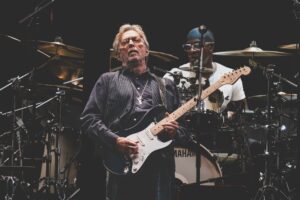

Cream’s performance at Winterland Arena in 1968 is often considered the benchmark for blazing blues-rock guitar solos. Listening to Eric Clapton wow the crowd live feels like a greatest hits of everything you should be doing with the pentatonic scale to make your guitar “talk.”
Sure, the song is a Robert Johnson tune — but when most guitar players quake in fear, it’s over Clapton’s Gibson ES-335 coaxing a pair of Marshall stacks into that sweet harmonic doom.
Taking your noodling up a notch to actually play an Eric Clapton-style guitar solo comes down to combining both Major and Minor pentatonic tonalities while adding percussive rhythmic phrasing. Not for the faint of heart.
But nail these concepts in your playing, and you can stop playing Diablo and learn to manipulate tension and release like the British Blues Explosion.
Taking private guitar lessons or learning online is the best way to not only play songs, but internalize what makes certain players so incredible. Taking an Eric Clapton “Crossroads” lesson will teach you more than just any classic rock tune. You learn the session player mindset and the techniques you will need to own the stage.
When you’re learning to play any song, knowing the guitarist’s gear and era can really help you get your tone dialed in.
By 1968, Cream had kicked the “Beano” Les Paul in favor of a Clapton mainstay, his 1964 Gibson ES-335. Rolling back the tone knob on this semi-hollow electric gives you that signature woody sound, but with grit at higher volumes.
For pedal tone practice at home, you don’t need two stacks. However, a quality tube amp or high-gain digital modeler can help you achieve this sweet spot. A good “woman tone” has a high-gain sound but with the high end rolled off.
Music is half inspiration and half truthful repetition of what is inspiring you. To truly understand how to play guitar like Eric Clapton, you need to start by analyzing the song.
“Crossroads” is essentially a sped-up jam session of 12-bar blues. If you know your blues guitar riff basics, you already know how to play this song. The real challenge with “Crossroads” is the tempo. If your speed isn’t up to par, you will cheat yourself out of some solid practice time — trying to play through this song too fast will expose holes in your technique.
If you haven’t taken time to cultivate your economy picking, or split your beats into readable subdivisions, now is “the time”! Start with a metronome and learn to groove with the “Texas shuffle” feel of this song before attempting to play through at full speed.
Let’s talk about the infamous guitar riff that started this whole lesson.
Most standard blues shuffles alternate between the bottom E and A-string. However, this riff accents both the A-string and the D-string.
Snap the strings! Eric’s touch is superlight on this riff, which is what allows him to achieve maximum attack with such clarity.
If you find yourself struggling with this technique, stop and look at your hand. Where is your thumb positioned? Are you playing guitar with your thumb curled over the top of the neck? For this riff, try lowering your thumb position to gain leverage on those 7th and 8th frets with your pinky.
This exercise keeps you from developing “lazy” habits in your muscle memory.
Once the vocals stop, you’re on your own…
The guitar solo from “Crossroads” is actually two different solos seamlessly stitched together. This means there is literally no breaking in the phrasing. To shred like Eric Clapton you have to start thinking outside of “box one” (the Minor pentatonic).
Listen to basically any solo by Eric Clapton and you will hear him toggle between two pentatonic scales. Minor pentatonic was his canvas, but he would lay major pentatonic quotes over top of his minor scale lines to make them sound sweet.”
Practice alternating between an A minor pentatonic scale and an A major pentatonic scale.
When Eric Clapton hits a bent note, he doesn’t always pick it. Sometimes he will start on the note below and scoot his way up. This gives his bends a real vocal quality. His vibrato is even wider than most players! Practice vibrating with your wrist (not your fingers) to get that big “Shed” tone.
Listen closely to the rhythmic phrasing of this solo. Eric Clapton loves stacking triplets over straight eighths. Your goal is to sound like you’re itching to play the next note.
If your speed has plateaued or you find yourself tensing up during more advanced legato runs, it might be time to brush up on some guitar mechanics.
Incorporating high-intensity muscle memory drills into your practice schedule is critical if you consider yourself an intermediate player looking to take the next step towards becoming a solo monster. Instead of browsing through dozens of poorly formatted YouTube tabs, step into the modern age and learn the theory behind why we play notes at certain points of a song.
At The Shred Shed we teach you to think like a professional guitarist. You will learn exercises to help maximize fretboard knowledge and minimize stress. Take our standard “Crossroads” guitar lesson for a spin.
You won’t find any guitar tabs that just tell you to “play the notes.” Just solid learning and tips.
Before you flip over some of the Winterland performances, remember this was still standard studio pace for Clapton. Focus on the main melody of the solo and the rhythmic nuances he places on certain notes. You will get faster by trying to play the song, not wearing down your fingers open exerting every ounce of energy into shredding.
Whether you are looking to clean up your legato technique or spice up your writing with more “groove,” the music theory and technique concepts covered in our guitar lessons will help you elevate your craft as a guitarist.
Give up on getting “good enough.” Master your technique with purposeful practice and routines that push you into an uncomfortable zone. That’s how you go from playing guitar to making music.
The reason people never feel like they are making progress with guitar tabs is because there is no easy way to compile decent songs into a cohesive learning journey. At The Shred Shed, we don’t want you to waste another week trying to figure out Mark Tremonti’s tapping technique alone. Subscribe to The Shred Shed to learn some of the best online guitar solos from the legends.
5 Easy Eric Clapton Songs Every Guitarist Should Learn

The 30 Minute Guitar Practice Routine That Actually Works

How to Play Like Freddie King — Signature Licks and Style Guide
10 Easy Blues Songs Every Beginner Guitarist Should Learn First

How to Play “Pride and Joy” by Stevie Ray Vaughan

How to Play Guitar Like Jerry Garcia